


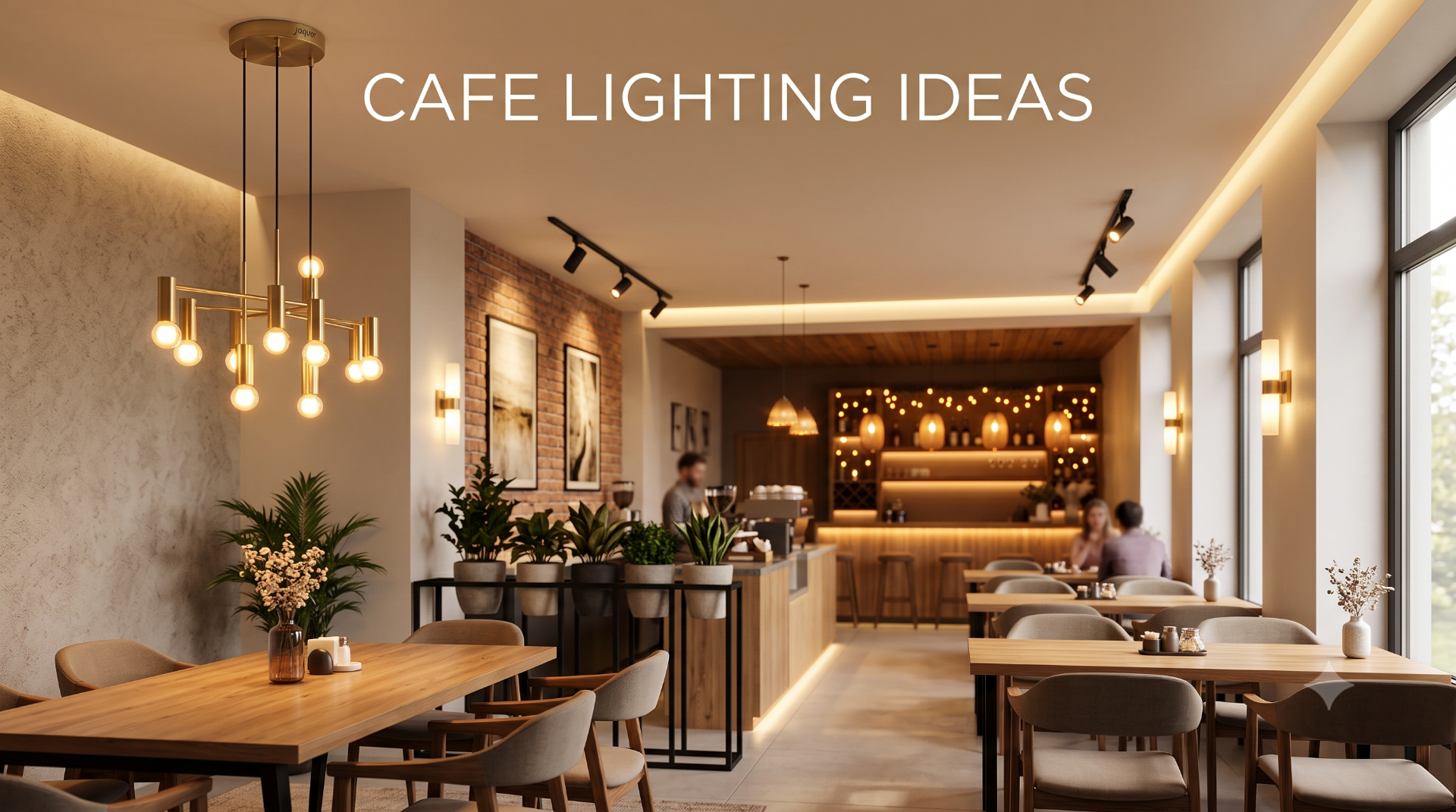
A successful café is built around more than furniture, finishes and food. The way light moves through the space can determine whether a room feels open or intimate, energetic or relaxed, functional or atmospheric.
Lighting also has to work across different types of café environments. A compact urban coffee shop, a spacious all-day café, a bakery with prominent product displays and a restaurant-style café may all require completely different lighting approaches.
This makes lighting design less about selecting individual fixtures and more about understanding the relationship between illumination, architecture and human behaviour.
The strongest café interiors use lighting in layers. General illumination establishes comfort. Focused light gives definition to tables and counters. Accent lighting brings attention to selected architectural elements, while decorative fixtures contribute to the identity of the space.
Jaquar's global lighting portfolio covers indoor, outdoor, decorative and lamp/accessory categories, creating a broad foundation for different residential and commercial lighting applications.
Understanding the Role of Lighting in a Café
Customers experience a café at different visual levels.
They see the overall room when they enter. They then notice the counter, seating arrangement, menu and surrounding details. Once seated, their attention shifts towards the table, food and people around them.
Lighting should respond to this sequence.
A good lighting scheme therefore creates a visual hierarchy rather than treating the entire room as one continuous surface.
The general principle is simple:
Illuminate what needs to be seen, highlight what deserves attention and allow everything else to support the composition.
This approach can be applied to cafés of almost any size or design style.
1. Begin With General Indoor Lighting
Indoor lighting should establish the basic visual comfort of the café.
It needs to support circulation, seating and staff activity without creating unnecessary brightness.
Jaquar's indoor lighting portfolio includes categories such as surface, hanging, recessed and track lighting, providing different approaches to general and focused illumination in commercial interiors.
Recessed solutions can maintain a relatively clean ceiling appearance. Surface lighting can work where recessed installation is unsuitable. Track lighting can provide flexibility where individual areas need more directed illumination.
The choice should follow the architecture rather than the other way around.
2. Use Pendant Lights to Define Tables
Pendants are especially effective in cafés because they combine illumination with visual identity.
A single pendant can define a small table. Multiple fixtures can establish rhythm above a communal table. A cluster can create a focal point within a larger room.
Jaquar's global decorative lighting portfolio includes a broad selection of pendant and ceiling-light designs, including clear-glass and other decorative forms.
When selecting pendants, consider:
- Ceiling height
- Table dimensions
- Fixture scale
- Customer sightlines
- Relationship with surrounding furniture
- Overall interior style
A pendant should feel connected to the table below it rather than simply suspended from the ceiling.
3. Use Recessed Lighting for a Clean Foundation
Some café interiors are intentionally understated.
In such spaces, recessed lighting can provide general illumination while allowing architectural materials, furniture and decorative elements to remain visually dominant.
Jaquar's global portfolio includes recessed downlighting options for indoor applications.
This type of lighting can be useful where designers want a clean ceiling plane and controlled distribution.
The important point is not to rely exclusively on recessed fixtures. Even a minimalist café can benefit from a few carefully positioned decorative or accent elements.
4. Create Layers Instead of Uniform Brightness
Uniform illumination can make a café feel flat.
Instead, consider three broad levels:
Background
The general illumination that allows people to move around comfortably.
Functional
Lighting directed towards tables, counters, menus or other areas where people need clearer visibility.
Decorative and accent
Lighting used to establish mood, highlight architecture or contribute to the interior identity.
The difference between these levels does not have to be dramatic. Subtle variations are often enough to create depth.
5. Give the Counter Appropriate Attention
The counter often acts as the visual anchor of a café.
It needs sufficient light for practical reasons, but it may also contain branding, menu boards, display shelving or distinctive finishes.
Lighting can reinforce these elements without making the counter excessively bright.
Track or focused indoor lighting can be useful when specific areas need directional emphasis, while decorative fixtures can contribute to the overall design language.
The counter should feel important without visually overpowering customers seated elsewhere.
6. Use Wall Lamps to Break Up Large Surfaces
Walls can play a significant role in a café's atmosphere.
A long, uninterrupted wall may feel visually empty, while a wall with carefully positioned illumination can create rhythm and depth.
Decorative wall lamps are particularly useful for this purpose. Jaquar's global portfolio includes a variety of wall-lamp designs, providing options ranging from simpler fixtures to more decorative forms.
Wall lighting can be particularly effective:
- Along seating walls
- In corridors
- Near entrances
- Around architectural niches
- In lounge areas
Rather than illuminating every wall, select surfaces that contribute to the overall composition.
7. Use Decorative Lighting to Establish Character
Decorative lighting is often the most recognisable part of a café's lighting scheme.
A distinctive pendant can become part of the interior identity. A series of wall lamps can establish rhythm. A chandelier can act as a focal point in a high-ceilinged café.
Jaquar's decorative lighting range includes chandeliers, pendants, floor lamps, table lamps and wall lamps.
The key is to maintain hierarchy.
If every fixture is visually distinctive, nothing feels distinctive. Choose a primary decorative language and let the supporting lighting remain relatively restrained.
8. Use Lighting to Create Different Customer Experiences
A café may have several types of customers at the same time.
Someone working on a laptop may prefer a well-defined table. A couple may prefer a more intimate corner. A group may need a larger, clearly illuminated table.
Lighting can help accommodate these different experiences.
A communal table might receive a repeated pendant arrangement. Individual seating could have more focused illumination. Lounge areas may use decorative floor or table lamps.
The architecture remains open, but the lighting subtly communicates that each zone serves a different purpose.
9. Consider Daylight Before Choosing Artificial Lighting
Daylight should be treated as part of the lighting system.
A café with extensive glazing may receive strong natural light during certain hours, while deeper areas may remain comparatively dark.
The artificial lighting should therefore be planned according to the actual daylight conditions.
This is especially important in cafés operating throughout the day. The lighting that feels balanced at 10 a.m. may feel inadequate after sunset.
Evaluate the space during:
- Morning
- Midday
- Late afternoon
- Evening
This simple process can reveal major differences in how the same fixtures are perceived.
10. Think About Colour Consistency
The apparent colour of light influences the atmosphere and the way interior materials are perceived.
A warm visual character may support an intimate café setting. A more neutral environment may suit contemporary, work-oriented spaces.
Neither is inherently correct.
The important consideration is that the chosen lighting works with the interior palette and remains visually consistent across adjacent areas.
Mixing dramatically different light colours can make one seating zone look disconnected from another.
11. Highlight Architectural Features Selectively
Lighting can be used to draw attention to:
- Textured walls
- Columns
- Ceiling details
- Decorative panels
- Display areas
- Feature surfaces
However, not every architectural feature needs to be highlighted.
Select two or three important elements and let them carry the visual emphasis.
This creates a stronger composition than illuminating everything equally.
12. Use Track Lighting Where Flexibility Matters
Track lighting can be useful in café environments where furniture layouts or display arrangements may change.
Individual light positions can help direct illumination towards different areas without redesigning the entire ceiling.
Jaquar's indoor lighting portfolio includes track lighting as one of its categories for commercial interiors.
This can be particularly relevant to cafés with:
- Changing display areas
- Flexible seating
- Art or decorative installations
- Product displays
- Multiple activity zones
The aim should still be controlled illumination rather than excessive directional lighting.
13. Make Small Cafés Feel More Spacious
Small cafés require restraint.
Large decorative fixtures may consume too much visual space. Excessive ceiling lighting can create a busy appearance.
A compact indoor lighting foundation combined with selected pendants or wall lamps can create sufficient variation without overcrowding the interior.
Lighting can also help establish depth. A slightly brighter focal area toward the rear of the café can encourage the eye to move through the space.
14. Use High Ceilings to Your Advantage
High ceilings provide an opportunity to introduce vertical design elements.
Pendant fixtures can visually connect the ceiling to the seating below. Chandeliers can create a central focal point in larger spaces.
The fixture should still be appropriately scaled.
A very small decorative fixture can disappear in a large volume, while an oversized fixture can dominate the entire room.
Scale should therefore be assessed in relation to both the ceiling and the furniture.
15. Consider Glare at Seated Eye Level
A lighting design can look excellent on paper and still feel uncomfortable in reality.
Customers spend much of their time sitting. Their eye level is therefore one of the most important perspectives from which to evaluate fixtures.
Check whether bright sources are visible directly across the table. Also check whether reflective surfaces create distracting reflections.
The goal is comfortable illumination rather than maximum visual intensity.
16. Use Lamps to Add Smaller Pools of Light
Floor and table lamps can add another layer to selected areas.
They are particularly useful in lounge-style café environments where a more relaxed atmosphere is desired.
Jaquar's decorative portfolio includes floor lamps and table lamps alongside other decorative lighting categories.
Because these fixtures are more visually prominent than concealed lighting, they should be treated as furniture-like design elements.
Their position should also leave adequate room for customer movement and cleaning.
17. Choose Lighting According to Café Concept
There is no universal lighting scheme for every café.
Consider the intended experience.
A quick-service coffee shop may need clear, efficient illumination and a straightforward visual environment. A slow-dining café may use more decorative layers. A café that transitions into an evening venue may require greater atmospheric flexibility.
The lighting should therefore answer a fundamental question:
What should customers feel comfortable doing here?
Once that is established, the lighting hierarchy becomes easier to define.
18. Avoid Common Lighting Mistakes
Overusing one fixture type
Even excellent fixtures can create a monotonous environment when used everywhere.
Making every area equally bright
This removes visual hierarchy.
Ignoring the counter
The counter needs both functional and visual attention.
Choosing decorative fixtures by appearance alone
A fixture must work with the ceiling, furniture, sightlines and maintenance requirements.
Forgetting the evening environment
Daylight can hide weaknesses that become obvious after sunset.
Mixing unrelated styles
A café can quickly appear visually inconsistent when every area uses a different design language.
19. Build a Simple Lighting Hierarchy
A useful starting framework is:
Layer 1: General indoor illumination
Provides comfortable visibility across the café.
Layer 2: Focused lighting
Defines tables, counters and selected functional areas.
Layer 3: Accent lighting
Highlights architectural or visual features.
Layer 4: Decorative lighting
Adds identity, character and visual interest.
Not every project needs every layer at the same intensity. The correct balance depends on the space.
20. Review the Finished Space as a Customer Would
Before finalising the lighting design, walk through the café from the customer's perspective.
Enter through the main entrance.
Look towards the counter.
Sit at different tables.
Look across the room.
Check the view towards windows and doors.
Observe the lighting after sunset.
This process often reveals issues that are invisible on drawings.
The most effective lighting plans are not necessarily the most technically complicated. They are the ones that respond accurately to how people actually experience the space.
Conclusion
Café lighting should bring together functionality, atmosphere and interior identity. The most successful spaces use different layers of illumination rather than relying on one fixture type or making every surface equally bright.
Indoor lighting can establish the foundation. Pendants can define tables. Track or focused lighting can respond to changing functional areas. Wall lamps can add depth, while decorative fixtures can give the café a recognisable visual character.
Jaquar's global lighting portfolio brings together indoor, decorative, outdoor and lamp/accessory categories, with options including recessed, surface, hanging and track lighting as well as decorative pendants and wall lamps. This breadth allows lighting to be approached as a complete spatial system rather than as a collection of individual fixtures.
For designers, the objective is ultimately simple: create enough light to support comfortable activity while using contrast, scale and carefully selected fixtures to give the space character.
FAQs
- What are the best cafe lighting ideas for a modern interior?
A layered combination of indoor lighting, pendant fixtures, focused illumination and selected decorative lights can create a modern café environment without making it visually crowded. - Are recessed lights enough for a café?
Recessed lights can provide a strong foundation for general illumination, but combining them with focused and decorative lighting usually creates greater depth and visual interest. - When should track lighting be used in a café?
Track lighting can be useful where specific areas need directional illumination or where seating, displays or interior arrangements may change over time. - How can lighting make a café more comfortable?
Comfort improves when general illumination is balanced with focused table lighting and controlled decorative accents. Avoiding glare and excessively bright fixtures is equally important. - How should I choose decorative lighting for a café?
Consider the café's architecture, ceiling height, furniture scale and overall design language. Decorative fixtures should reinforce the interior rather than compete with every other design element.