


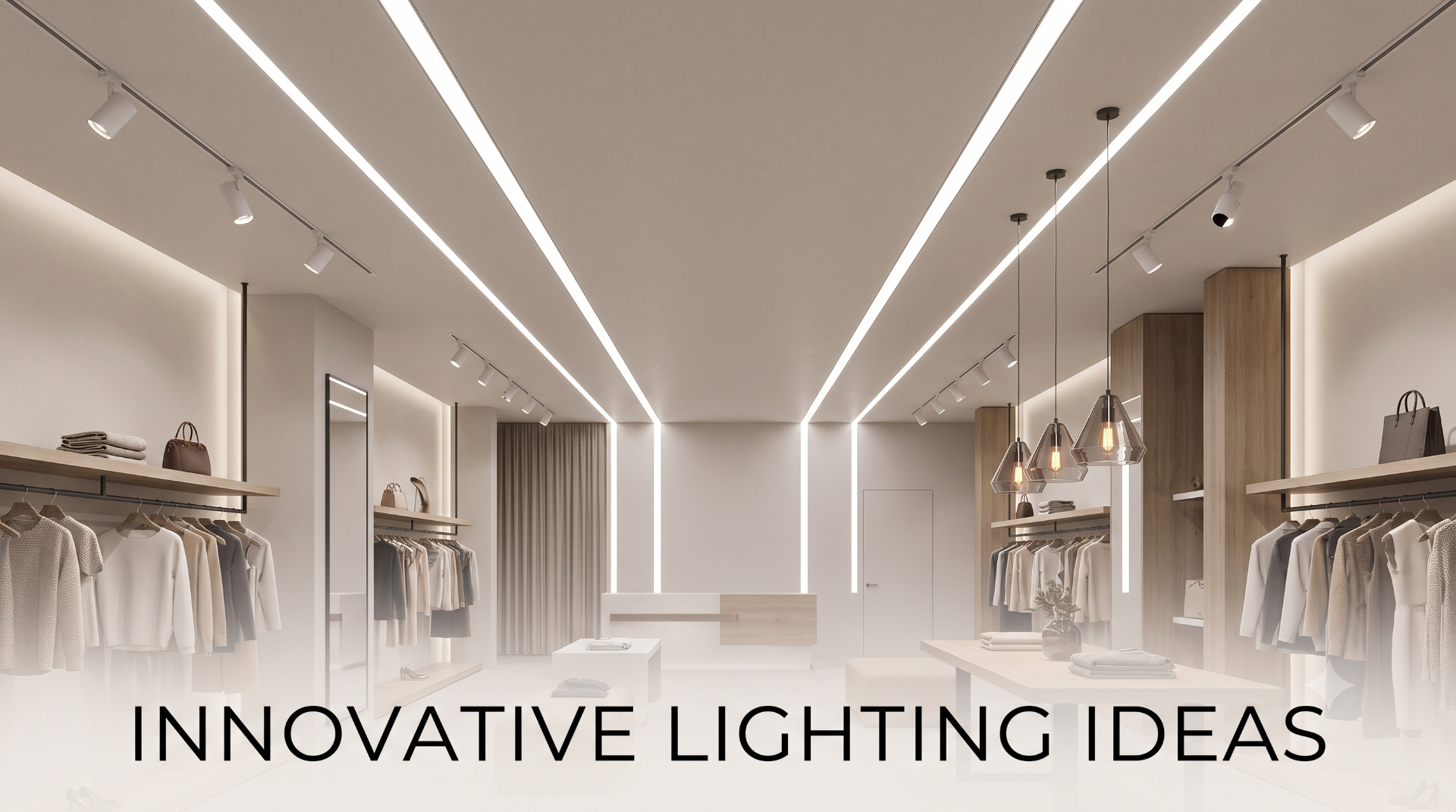
Retail spaces have become increasingly experiential. A store is no longer defined only by shelves, counters and product displays. Architecture, materials, furniture, signage and lighting work together to shape how customers understand the environment.
Among these elements, lighting has a particularly versatile role.
It can make a product display more noticeable, establish a route through the store, create a focal point at the entrance or introduce warmth into an otherwise minimal interior. It can also respond to changing merchandise and different times of day.
This is why innovative retail lighting is less about unusual fixtures and more about using familiar lighting principles in thoughtful ways.
A well-designed retail environment knows where to be bright, where to be subtle and where to direct attention.
The Role of Lighting in Modern Retail
Retail lighting has three broad responsibilities.
The first is visibility. Customers need to see products, signage, displays and circulation routes clearly.
The second is atmosphere. The lighting should support the character of the store rather than making the environment feel purely functional.
The third is hierarchy. Some products, displays and architectural features need greater visual emphasis than others.
These responsibilities are best addressed through layers rather than one uniform lighting system.
1. Establish a Strong Indoor Lighting Foundation
General indoor lighting creates the baseline for the entire store.
Recessed fixtures can provide an integrated appearance. Surface lighting can work where visible fixtures complement the architecture. Linear solutions can reinforce long ceiling structures, while general lighting can provide broad illumination.
The layout should follow the store rather than simply following the ceiling grid.
Consider customer circulation, display furniture, shelves, counters and major architectural features before finalising fixture positions.
Jaquar's global indoor lighting portfolio includes recessed, surface, linear, track and general lighting categories that can be used for different commercial environments.
2. Use Track Lighting to Respond to Changing Displays
Retail merchandising changes continuously.
A new collection can change the location of visual emphasis. A seasonal campaign can introduce a new feature display. Furniture may be moved to create a different customer journey.
Track lighting provides flexibility in such environments.
Focused fixtures can be directed towards different merchandise areas as the layout changes.
This makes track lighting particularly useful in fashion stores, showrooms and lifestyle retail environments where displays are frequently updated.
3. Use Accent Lighting to Build Visual Hierarchy
Customers should not be presented with a store where every object appears equally important.
Accent lighting helps establish priorities.
A selected product wall can receive stronger visual emphasis. A central display can become a destination. A distinctive architectural element can help define the identity of the store.
The surrounding areas can remain more restrained.
This contrast helps the customer understand the space without requiring excessive signage.
4. Use Linear Lighting to Complement Modern Architecture
Linear lighting can work particularly well in contemporary retail interiors because its geometry naturally relates to architectural lines.
It can define aisles, reinforce ceiling features or create visual continuity through long spaces.
The best results occur when the linear form has a clear relationship with the architecture.
Using linear lighting simply because it appears modern can produce an unnecessary layer. Its position should have a reason.
5. Introduce Pendant Lighting at Important Touchpoints
Pendants can bring lighting closer to the customer and create visual scale.
They are particularly effective around checkout counters, consultation desks, feature displays and selected seating areas.
In larger stores, a group of coordinated pendants can create a focal zone.
In smaller stores, one carefully chosen pendant may be enough.
The fixture should relate to the furniture beneath it and the architecture around it.
6. Use Decorative Lighting as Part of the Store Identity
Decorative lighting can give a retail interior a stronger personality.
Chandeliers, pendants, floor lamps and table lamps can be used selectively in areas where the fixture itself contributes to the design.
Wall lamps can also provide another visual layer along architectural surfaces.
The key is restraint.
Retail environments already contain substantial visual information. Decorative lighting should complement the merchandise and architecture rather than competing with them.
Jaquar's decorative lighting portfolio includes chandeliers, pendants, floor lamps, table lamps and wall lamps that can be considered for different retail applications.
7. Make the Entrance a Visual Introduction
The entrance should establish the character of the store quickly.
Lighting can give the doorway greater definition and create a visual transition from the surrounding environment.
Once inside, the lighting can guide customers toward the main display or circulation route.
The transition does not need to be dramatic.
A subtle difference in visual emphasis can be enough to make the entrance feel purposeful.
8. Create a Natural Customer Journey
Lighting can work alongside floor planning to influence how customers move.
A sequence of illuminated displays can draw attention further into the store. A feature zone can create a destination. A change in lighting character can signal the beginning of another department.
The important thing is subtlety.
The customer journey should feel natural rather than artificially controlled.
9. Give Different Departments Distinct Characters
Large retail environments can benefit from subtle lighting differences between departments.
A fashion section may require focused display lighting. A lifestyle section may benefit from decorative fixtures. A showroom consultation area may need a calmer and more balanced atmosphere.
These differences help customers understand the structure of the store.
However, the underlying visual language should remain connected.
10. Use Wall Lighting to Break Up Long Surfaces
Long retail walls can become visually repetitive.
Wall lamps can introduce points of interest without requiring additional floor space.
They can highlight architectural features, provide illumination around selected seating areas or create rhythm along a corridor.
This is particularly useful in minimalist stores where the architecture itself is part of the design.
11. Extend Lighting Beyond the Store Interior
The customer experience often begins before entering the store.
Exterior façades, entrances, walkways and surrounding commercial areas can influence the first impression.
Outdoor lighting can help establish continuity between the building and interior.
Jaquar's global outdoor lighting portfolio includes linear, projector, street, surface, pole, bollard, post-top, ground-recessed and wall-recessed categories, allowing different exterior requirements to be considered according to the space.
The objective is not to illuminate every external surface equally. Selected areas can provide enough definition to create a clear transition.
12. Use Lighting to Support Different Store Sizes
The same lighting concept should not simply be scaled up or down.
Small Stores
Use a restrained general lighting foundation and selected accent or decorative fixtures. Avoid overcrowding the ceiling.
Medium Stores
Combine general lighting with focused merchandise illumination and a few visual anchors.
Large Stores
Use zoning, linear lighting, track lighting and selected decorative fixtures to establish hierarchy across the larger floor area.
Scale matters as much as fixture type.
13. Consider Ceiling Height
Ceiling height changes the visual relationship between the fixture and the customer.
Lower ceilings generally work well with recessed or compact surface solutions.
Higher ceilings allow hanging fixtures to become more prominent.
A large chandelier or pendant can also help visually connect a high ceiling with the activity below.
The fixture should always be proportional to the space.
14. Design Around Natural Daylight
Retail spaces with large windows can change dramatically throughout the day.
Daylight may dominate the interior during the morning or afternoon, while artificial lighting becomes more important later.
The lighting design should account for this transition.
Where suitable controls are available, separate zones can be adjusted according to daylight and operating conditions.
This creates a more consistent experience throughout the store.
15. Select Colour Temperature According to the Brand Environment
Colour temperature affects the visual character of a retail space.
Warmer illumination can produce a more relaxed atmosphere. Neutral illumination can create a cleaner and more contemporary environment.
The decision should consider:
- Store category
- Interior materials
- Product characteristics
- Natural daylight
- Operating hours
- Overall brand identity
Consistency between connected spaces is particularly important.
16. Protect Visual Comfort
Retail lighting should never make browsing uncomfortable.
Glare is especially important because customers spend time looking at products from different angles.
Fixtures should be positioned carefully so that intense light sources do not repeatedly appear in the customer's field of vision.
The same consideration applies to staff areas and service counters.
Good retail lighting should be noticed for its effect, not because it causes discomfort.
17. Use Repetition to Create Design Rhythm
Repeated fixtures can help unify a retail environment.
A sequence of pendants above a counter can create rhythm. Repeated wall lamps can establish continuity along a long wall. Recessed fixtures can follow a regular architectural pattern.
Repetition also prevents the store from feeling visually fragmented.
Instead of choosing a different fixture for every area, identify where a particular design can be repeated effectively.
18. Make Lighting Adaptable to Merchandising
One of the most important considerations in modern retail is change.
Displays rarely remain fixed.
A lighting scheme that is too rigid may work initially but become less effective as the store evolves.
Flexible indoor and track lighting can support changing displays, while decorative fixtures can remain as stable elements of the store's visual identity.
This creates a balance between adaptability and consistency.
19. Avoid the Most Common Retail Lighting Mistakes
Over-lighting the entire store: Brightness alone does not create a better customer experience.
Treating every product equally: Visual hierarchy helps customers understand where to focus.
Using too many fixture styles: Variety without a visual relationship can make the interior feel disconnected.
Ignoring the walls: A ceiling-only approach can leave the interior flat.
Choosing fixtures without considering scale: A fixture should relate to the surrounding architecture and furniture.
Forgetting outdoor areas: Exterior lighting forms part of the first and last impression.
Ignoring future merchandising changes: A fixed lighting plan may become restrictive.
20. A Practical Framework for Choosing Retail Lighting
A useful process can be broken into five stages.
Stage 1: Understand the Store
Identify the store category, customer journey, operating hours and visual identity.
Stage 2: Map the Space
Mark entrances, circulation routes, displays, counters, consultation areas and architectural features.
Stage 3: Assign Lighting Roles
Decide where general, focused, decorative, wall and outdoor lighting are required.
Stage 4: Select Fixtures
Choose fixtures based on scale, position, visual character and flexibility.
Stage 5: Review from the Customer Perspective
Walk through the store and assess what customers will see first, where their attention moves and whether any lighting creates distraction.
This process keeps design decisions connected to the actual retail experience.
Conclusion
Modern retail lighting should do more than make merchandise visible. It should help customers understand the space, create visual hierarchy, support changing displays and contribute to the overall character of the store.
The most effective schemes combine several lighting layers: indoor lighting for the foundation, track and focused lighting for merchandise, decorative fixtures for identity, wall lighting for depth and outdoor solutions for the transition between exterior and interior.
Jaquar's global lighting portfolio offers these categories across indoor, decorative and outdoor applications, allowing retailers and designers to develop a more cohesive approach to different parts of a commercial environment. The emphasis remains on choosing complementary solutions that serve the space rather than adding fixtures simply for visual effect.
FAQs
- What are innovative lighting ideas for modern retail stores?
Useful approaches include layered lighting, flexible track lighting, linear architectural lighting, focused merchandise illumination, selective decorative fixtures and coordinated outdoor lighting. - Why is layered lighting important in retail?
Different layers perform different jobs. General lighting provides visibility, focused lighting highlights merchandise, while decorative and wall lighting contribute to atmosphere and identity. - How can track lighting improve retail displays?
Track lighting can provide flexibility by allowing focused fixtures to be directed towards changing displays and merchandise areas. - What role does decorative lighting play in retail design?
Decorative fixtures can establish visual identity and create focal points around entrances, counters, displays and selected customer areas. - How should retailers choose lighting for changing store layouts?
Prioritise flexible lighting where merchandising changes frequently, while using consistent decorative elements to maintain the store's visual identity.