


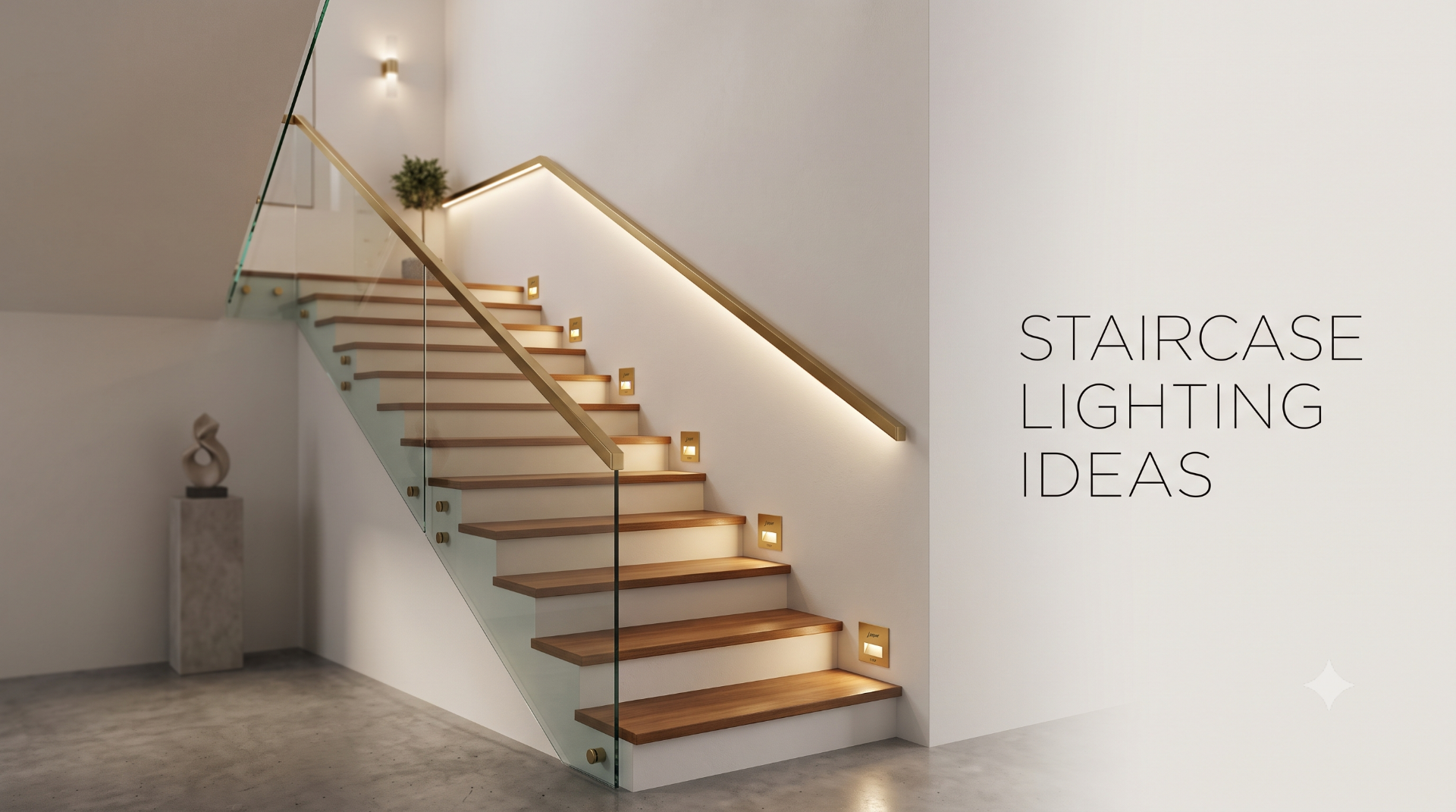
A staircase does more than connect one floor to another. In many homes, it sits at the intersection of several spaces, making it both a functional route and an important part of the interior architecture.
That makes staircase lighting a design problem as much as a lighting problem.
The right fixture can make steps easier to read, highlight the geometry of the staircase and create a gentle transition between different areas of a home. The wrong fixture can produce glare, create uneven shadows or simply make the staircase feel disconnected from the rest of the interior.
The most effective approach is therefore not to ask, “Which light looks best on stairs?” Instead, begin with a more useful question: What does this staircase need from its lighting?
From recessed stair and foot lights to wall lamps and carefully positioned ceiling lighting, there are several ways to approach the task. The right choice depends on the staircase's structure, surrounding architecture, materials, natural light and how the space is used.
This guide covers practical staircase lighting ideas that can be adapted to different residential environments while keeping visibility, comfort and design at the centre.
What Makes Staircase Lighting Different?
Lighting a staircase is different from lighting a conventional room because the surface being illuminated changes continuously.
A staircase contains:
- Horizontal treads
- Vertical risers
- Landings
- Direction changes
- Side walls
- Handrails
- Open or enclosed sections
Each element affects how light is distributed.
The goal is not necessarily to make every part equally bright. Instead, the lighting should establish enough contrast for the steps and changes in level to remain clear.
A well-designed staircase should also be comfortable to use from both directions. Someone walking down the stairs should not be looking directly into a bright light source installed for someone walking upward.
This is why placement is often more important than fixture size.
Jaquar's global lighting portfolio includes dedicated stair lights alongside decorative, indoor, outdoor and lamp/accessory categories.
1. Recessed Stair Lights
Recessed lighting creates one of the cleanest approaches to stair illumination.
Because the fixture is integrated into the wall or staircase structure, the hardware remains visually discreet while light is directed toward the steps.
This approach suits:
- Contemporary homes
- Minimal interiors
- Solid staircase walls
- Straight staircases
- Residential projects where visual simplicity is important
The strength of recessed lighting is that it can provide a useful lighting effect without introducing another large object into the room.
Jaquar's dedicated stair-light category includes wall-recessed LED foot-light solutions designed for stair illumination.
2. Foot Lights for Low-Level Visibility
Foot lights are positioned closer to the level of the stairs and are particularly useful when the objective is to illuminate movement without filling the entire stairwell with bright overhead light.
They can work effectively on:
- Internal staircases
- Long stair runs
- Staircases with limited ambient illumination
- Night-time circulation routes
- Residential staircases connecting private areas
Low-level illumination can also create a useful secondary lighting layer.
For example, a homeowner may use broader ceiling lighting when entertaining or cleaning, while lower-level stair lights provide a more restrained solution during late hours.
3. Wall Lamps for Architectural Character
A staircase wall can become an important part of the lighting design.
Wall lamps can provide side illumination while contributing to the visual character of the space.
They are especially useful where the staircase has:
- A large blank wall
- A visible landing
- A feature wall
- A connection to a living or entrance area
- Decorative elements that benefit from additional illumination
Jaquar's global wall-lamp portfolio includes multiple decorative wall fixtures suitable for different interior styles.
The key is to avoid placing the fixture where it becomes a source of glare or interferes with movement.
4. Use Ceiling Lighting for General Illumination
Ceiling lighting can establish the overall brightness of a staircase and surrounding area.
It is particularly useful for larger stairwells or open-plan spaces where the staircase is visually connected to another room.
However, ceiling lighting alone may not define every step clearly.
This is where layering becomes useful:
Ceiling lighting establishes general illumination.
Stair lighting gives the steps definition.
Wall or decorative lighting contributes visual character.
This approach avoids asking one fixture type to solve every requirement.
The global portfolio includes ceiling and pendant lighting options as part of its decorative lighting range.
5. Staircase Lighting for Double-Height Spaces
Double-height staircases often have impressive proportions but can be difficult to light evenly.
The vertical distance between the staircase and ceiling means that a ceiling fixture may illuminate the surrounding space without providing sufficient definition close to the steps.
Start at the staircase itself.
Determine where additional illumination is required, then consider the upper volume as a separate layer.
A practical composition can include:
- Low-level stair illumination
- General ceiling lighting
- Lighting around landings
- Decorative lighting where appropriate
The result should preserve the scale of the space rather than turning the entire stairwell into one uniformly bright volume.
6. Lighting an Open-Riser Staircase
Open-riser stairs create a strong architectural effect because the space between the treads remains visually open.
That openness also makes lighting more visible from different angles.
A fixture that is comfortable when viewed from the bottom may produce glare when viewed from the side.
For this reason, open-riser staircases benefit from carefully controlled light distribution.
Avoid turning the underside of every step into a bright feature unless that effect is deliberately part of the design.
Often, subtle side illumination is enough to reveal the staircase geometry.
7. Lighting Straight Staircases
Straight stairs provide the simplest planning condition.
The lighting can follow the linear movement of the staircase.
A regular rhythm of low-level fixtures can create a strong architectural line, particularly when the staircase has a clean wall on one side.
The important consideration is spacing.
Fixtures that are too far apart can produce obvious dark gaps. Fixtures that are too close together may create unnecessary visual repetition.
The right spacing depends on the fixture's light distribution, the staircase dimensions and the surrounding ambient lighting.
8. Lighting L-Shaped and U-Shaped Stairs
Staircases that change direction require particular attention to the landing.
The landing should not become a dark interruption between two well-lit flights.
Think about the lighting as a continuous journey:
Approach → first flight → landing → second flight → upper space
Each section should provide enough visual information for the next.
A wall lamp can be useful around a landing where there is sufficient wall space. Ceiling illumination can work where the landing has its own ceiling zone.
The goal is continuity, not identical fixtures everywhere.
9. Use Materials to Guide the Lighting Design
Materials strongly influence the visual result.
A light-coloured wall may reflect illumination broadly. Dark finishes can absorb more light. Glass introduces reflections, while textured surfaces can become more prominent when light reaches them from the side.
Consider the staircase as a combination of surfaces rather than simply a collection of steps.
Ask how the lighting interacts with:
- Stair treads
- Risers
- Wall finishes
- Handrails
- Balustrades
- Flooring
- Architectural details
This is especially important in minimalist interiors, where a small lighting decision can have a significant visual effect.
10. Choose Lighting Based on the Surrounding Interior
A staircase should normally feel like part of the same home.
If the adjacent living space uses decorative pendants and wall lamps, the staircase can echo those forms without copying them.
If the surrounding interior uses discreet recessed lighting, a highly decorative stair fixture may look out of place.
Jaquar's global decorative portfolio includes chandeliers, pendants, floor lamps, table lamps and wall lamps, providing several lighting formats that can be coordinated across an interior.
The objective is not to make every fixture identical. It is to create visual relationships between them.
11. Warm, Neutral and Cool Lighting
Colour temperature can significantly affect how a staircase feels.
Warm light tends to produce a softer atmosphere and can complement timber, warm neutrals and relaxed residential interiors.
Neutral light offers a balanced appearance and can work well where the staircase needs clear general illumination.
Cooler light creates a sharper visual character and may suit interiors built around cooler materials and finishes.
Rather than choosing a colour temperature simply because it is fashionable, look at the existing lighting in the surrounding spaces.
A staircase connecting two rooms should not suddenly feel as though it belongs to a different interior.
12. Think About Day and Night Separately
A staircase may need very little artificial light during daylight hours and substantially more after sunset.
That does not mean the lighting should be designed around only one condition.
Consider two scenarios:
Daytime
Natural light provides most of the illumination. Fixtures should remain visually unobtrusive.
Evening and night
Artificial lighting becomes the main source. Step definition, glare control and comfortable movement become more important.
This approach can prevent over-lighting while still ensuring that the staircase remains functional after dark.
13. Staircase Lighting for Compact Homes
Compact spaces require restraint.
The objective is to provide sufficient illumination without adding unnecessary visual weight.
Recessed stair lights can be particularly useful because they occupy little visual space. Wall lamps can also work when there is enough wall clearance.
For narrow staircases, avoid large fixtures that project into circulation paths.
The lighting should follow the architecture rather than compete with it.
14. Staircase Lighting for Large Residential Spaces
Larger homes provide more opportunities for layered lighting.
A staircase may be visible from multiple rooms, have a large landing or sit beneath a double-height ceiling.
In such spaces, consider how the staircase looks from different viewpoints.
It should work from:
- The entrance
- The lower floor
- The upper landing
- Adjacent living spaces
- Different directions of travel
A lighting arrangement that looks attractive from one viewpoint but creates glare from another is not fully resolved.
15. Don't Use Brightness as the Only Measure
A brighter staircase is not automatically a better-lit staircase.
Excessive brightness can reduce contrast between different surfaces, create glare and make the surrounding areas appear darker by comparison.
Instead, look for balanced illumination.
The steps should be easy to identify. The landing should be visible. The surrounding architecture should retain its depth.
The best lighting often feels natural because it gives the eye exactly the information it needs without demanding attention.
16. Create a Separate Night-Time Layer
One of the most useful residential lighting strategies is to create a lower-intensity layer for night-time movement.
This can be particularly useful when the staircase connects bedrooms to living areas.
Instead of switching on all nearby lights, dedicated stair illumination can provide enough visibility for movement while keeping the surrounding spaces calmer.
This is not just a design decision. It is a practical consideration for homes where stairs are used throughout the day.
17. Consider Outdoor and Transitional Staircases Carefully
Where stairs connect interior and exterior areas, the lighting design needs to account for the change in environment.
The transition from an illuminated interior to a darker exterior can make stair visibility more difficult.
Jaquar's broader global lighting portfolio includes outdoor lighting solutions in addition to dedicated stair lights.
For outdoor or exposed applications, fixture selection should always follow the relevant environmental requirements rather than simply choosing a fixture because its appearance matches the interior.
18. Coordinate the Landing With the Staircase
The landing is often overlooked.
Yet it is where people pause, turn and change direction.
A beautifully illuminated staircase can still feel poorly designed if the landing is significantly darker.
Consider the landing part of the staircase lighting zone.
If there is a feature wall, a wall lamp may help. If there is a ceiling area, general lighting may be appropriate. If the landing opens directly into a room, its lighting should transition naturally into that room.
19. Maintenance Matters
Stair lighting is usually installed in areas that experience regular movement, dust and contact with surrounding surfaces.
Keep fixtures clean and inspect them periodically.
Pay particular attention to low-level fixtures because dust can be more noticeable near the floor.
For outdoor applications, fixtures should also be kept clear of leaves, dirt and other debris that may affect their performance.
Simple maintenance helps preserve both the practical and visual qualities of the lighting.
Common Staircase Lighting Mistakes
1. Depending entirely on one ceiling light
This can leave individual steps poorly defined.
2. Installing lights where they create glare
Visibility should never come at the expense of visual comfort.
3. Ignoring the landing
Changes in direction require the same attention as the main flights.
4. Using inconsistent fixture spacing
Irregularity can make the staircase feel visually unfinished.
5. Mixing unrelated colour temperatures
Connected areas generally benefit from a coherent lighting character.
6. Choosing fixtures only for appearance
The fixture should suit both the staircase architecture and the actual lighting requirement.
7. Over-lighting the staircase
Too much illumination can be as problematic as too little.
A Practical Staircase Lighting Checklist
Before finalising the lighting plan, consider:
Consideration | What to look for |
Staircase type | Straight, L-shaped, U-shaped, open-riser or enclosed |
Wall availability | Determines whether recessed or wall lighting is practical |
Natural light | Shows how much artificial lighting is needed |
Step finish | Affects reflection and contrast |
Handrail and balustrade | Can create shadows or reflections |
Landing | Needs clear illumination at direction changes |
Night-time use | May justify dedicated low-level lighting |
Adjacent rooms | Lighting should transition naturally |
Glare | Check the fixture from both directions |
Maintenance | Ensure fixtures remain accessible enough for upkeep |
Frequently Asked Questions
1. What type of lighting is best for a staircase?
Dedicated stair and foot lights are effective for illuminating steps directly. Depending on the architecture, they can be supported by wall lamps, downlights or ceiling lighting.
2. Are recessed stair lights suitable for modern homes?
Yes. Their discreet appearance makes them particularly suitable for contemporary interiors where the architecture and staircase materials should remain visually prominent.
3. Can wall lamps be used instead of stair lights?
Wall lamps can provide useful side illumination, but whether they can replace dedicated stair lighting depends on the staircase structure, light distribution and overall visibility requirements.
4. How should staircase lighting be positioned?
Lighting should illuminate the steps and landing without creating direct glare. The exact placement depends on the staircase layout, fixture distribution and surrounding lighting.
5. How many stair lights are required?
There is no universal number. It depends on staircase length, step dimensions, fixture output and distribution, surrounding ambient light and the desired visual effect. Consistent illumination is more important than simply increasing fixture count.
Conclusion
Good staircase lighting is a combination of architecture, visibility and restraint.
Start with the staircase rather than the fixture. Understand its geometry, identify where shadows occur, consider the surrounding lighting and then choose the most appropriate combination of stair, foot, wall or ceiling illumination.
The strongest solutions do not necessarily draw attention to the light source. They make the staircase easier to navigate, reveal its form and allow it to connect naturally with the rest of the interior.
Jaquar's global portfolio includes dedicated LED stair and foot-light solutions alongside wall lamps, ceiling and pendant lighting, decorative lighting and wider indoor and outdoor categories.
A coordinated lighting portfolio can make it easier to maintain consistency across functional and decorative applications. For staircase projects, that means creating lighting that serves everyday movement while contributing naturally to the character of the surrounding space.