


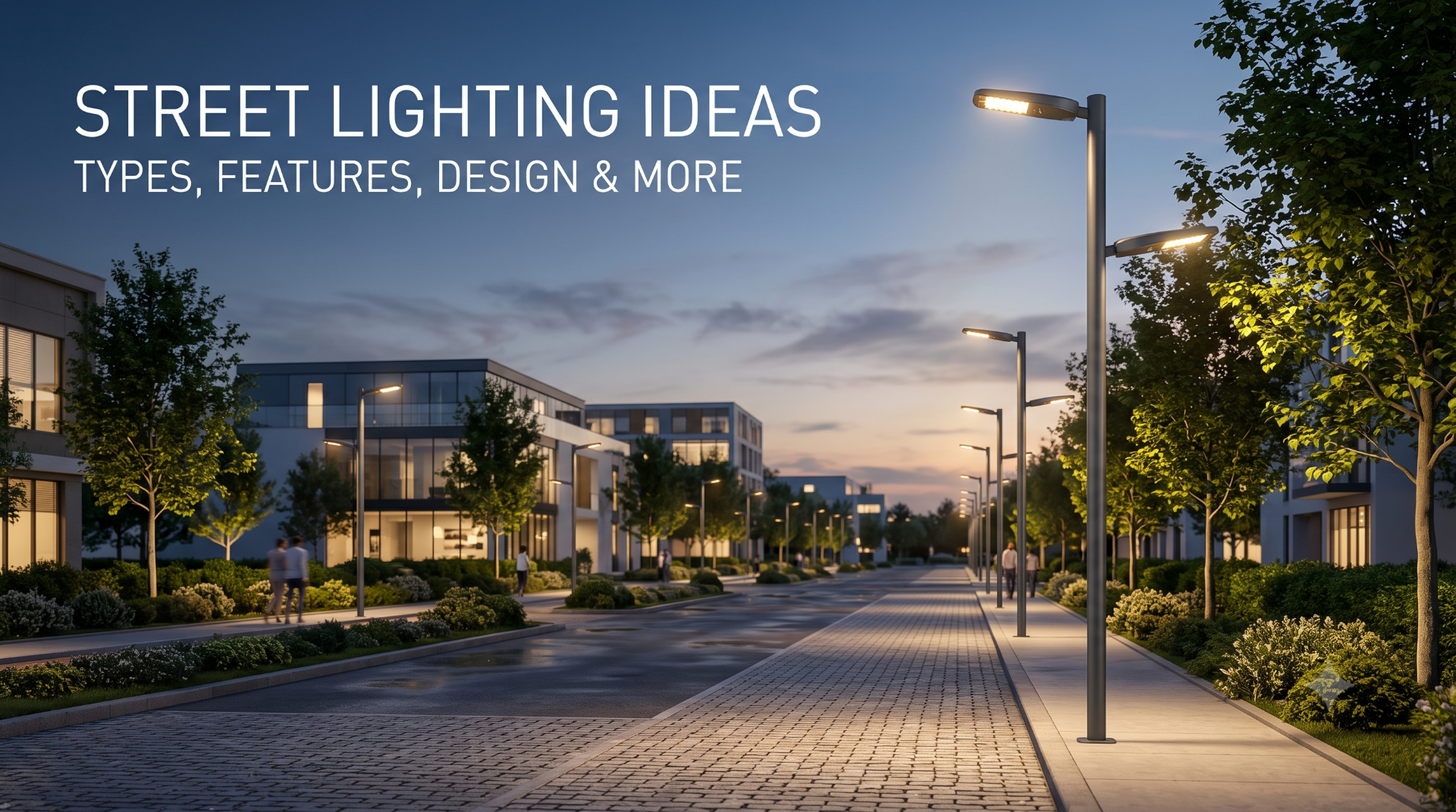
A well-designed street does not stop functioning when the sun goes down. Roads, pathways and public spaces continue to guide people through cities and communities, but their usability after dark depends heavily on how illumination has been planned.
Street lighting therefore sits at the intersection of infrastructure and design. It needs to support visibility and movement while also fitting naturally into the surrounding architecture and landscape.
From residential streets to highways, tunnels, commercial developments and public areas, the requirements can change considerably. Road width, traffic, pedestrian movement, mounting conditions and environmental exposure all influence the right lighting approach.
Jaquar's global lighting portfolio includes dedicated street-lighting solutions alongside broader outdoor categories such as pole, bollard, post-top, recessed and other outdoor lighting.
What Is Street Lighting Used For?
Street lighting provides artificial illumination for roads and outdoor circulation areas after dark.
Its primary role is to help people see and navigate the environment.
However, good street lighting can also:
- Establish visual continuity
- Define road hierarchy
- Support pedestrian movement
- Improve the perception of outdoor spaces
- Complement surrounding architecture
- Create a more organised nighttime streetscape
The key is to use illumination deliberately.
Types of Street Lighting
1. Standard Roadway Lighting
Roadway lighting is used for streets where vehicles and pedestrians need consistent visibility.
The fixture should distribute illumination across the road rather than concentrating light directly beneath the mounting point.
Jaquar's street-light portfolio includes multiple roadway configurations intended for different outdoor applications.
The final choice should be based on the road geometry and required coverage.
2. Highway Lighting
Highway environments demand a different scale of planning.
Road widths, vehicle speeds and longer distances make consistent illumination particularly important.
Jaquar identifies highways as one of the principal applications for its roadway lighting solutions.
The lighting design should follow the road rather than simply repeat a generic street-light arrangement.
3. Tunnel and Underpass Lighting
Enclosed roads have limited daylight and therefore require a continuous lighting approach.
Jaquar's roadway portfolio includes street-light applications specifically identified for tunnels and underpasses.
The main consideration is continuity: users should be able to understand the route without abrupt visual changes.
4. Residential Street Lighting
Residential streets require a comfortable balance between visibility and atmosphere.
The lighting should provide adequate roadway illumination while remaining compatible with homes, gardens and pedestrian areas.
5. Commercial and Public Areas
Commercial districts and public spaces may have higher pedestrian activity, entrances, parking areas and architectural features.
Street lighting can provide the functional base while other outdoor lighting can support adjacent areas.
Important Street Lighting Features
Light Distribution
One of the most important characteristics of a street light is how it distributes illumination.
Jaquar's roadway products include asymmetric beam options.
This is particularly relevant to roads because the target surface extends horizontally away from the fixture.
Good distribution can help reduce unnecessary illumination outside the intended area while providing useful coverage across the road.
Outdoor Protection
Outdoor fixtures must cope with exposure to environmental conditions.
Jaquar's street-light portfolio includes IP65 and IP66-rated solutions.
The appropriate protection level should always be considered in relation to the actual installation environment.
Construction
Jaquar describes its roadway lights with aluminium die-cast housing, protective coating and polycarbonate covers.
For designers, this reinforces an important point: street-light selection should consider long-term outdoor exposure rather than focusing only on appearance.
Colour Options
Jaquar's roadway lighting information includes warm white, neutral white and cool white options.
The right choice depends on the application.
Residential environments may call for a softer visual appearance, while road and industrial environments may benefit from a clearer, more neutral presentation.
Street Lighting Design Ideas
1. Design Around the Road, Not the Fixture
The road should be the starting point.
Determine its width, direction, junctions and surrounding areas before deciding where fixtures belong.
This prevents a common mistake: selecting a visually attractive fixture and attempting to make it work everywhere.
2. Establish a Consistent Rhythm
Street lights become part of the visual rhythm of a road.
Consistent spacing can make a long street feel more organised, while irregular placement can create visual confusion and uneven illumination.
Spacing should still respond to the actual lighting distribution rather than being based solely on appearance.
3. Create Hierarchy at Junctions
Intersections are important visual and functional points.
Lighting can help distinguish them from ordinary stretches of road.
The change does not necessarily need to be dramatic. A carefully planned lighting hierarchy can make junctions easier to recognise.
4. Consider Pedestrian Movement
Road lighting should not be planned only from the driver's perspective.
Pedestrian routes, crossings, entrances and waiting areas can all influence the lighting strategy.
Where additional illumination is required, complementary outdoor-lighting categories can help support these areas.
5. Coordinate With Architecture
Street lights are visible during the day as physical structures and at night through their illumination.
Their form should therefore complement the surrounding architecture.
Modern buildings may work well with clean, understated lighting forms, while other environments may call for a quieter fixture presence.
Street Lighting and Landscape
Roads frequently run through landscaped environments.
Trees, planting, walls and open areas influence how light travels and how the street is perceived.
Jaquar's broader outdoor lighting portfolio includes pole lights, bollards, post tops, ground-recessed and wall-recessed categories, providing additional options for outdoor environments beyond the roadway itself.
These should be treated as complementary layers.
Street lights establish functional roadway illumination.
Other outdoor fixtures can then support pathways, landscaping or architectural features where necessary.
This separation of roles generally creates a more balanced nighttime environment.
Street Lighting for Different Environments
Residential Developments
Use a comfortable, consistent lighting rhythm that supports roads and pedestrian movement without overwhelming surrounding homes.
Commercial Districts
Consider vehicles, pedestrians, entrances, parking and architecture together.
Highways
Prioritise consistent roadway coverage and suitability for the scale of the route.
Industrial Areas
Functional visibility and appropriate outdoor protection may be particularly important.
Public Spaces
Consider how the road interacts with pedestrian areas, buildings and landscape.
Tunnels and Underpasses
Focus on continuity and clear visual guidance.
How to Select the Right Street Light
Start With the Application
Ask where the fixture will actually be used.
A highway fixture does not automatically make sense for a residential street.
Understand the Road Geometry
Width, curves, intersections and lane arrangement influence how illumination should be distributed.
Consider Mounting
The relationship between mounting position and road surface affects the final light pattern.
Check Outdoor Conditions
Exposure to water, dust, heat and other environmental conditions should influence product selection.
Consider Visual Character
The street light should complement its surroundings rather than compete with them.
Think About Maintenance
A good street-lighting solution should be practical to inspect and maintain throughout its operational life.
Why Light Distribution Matters More Than Brightness Alone
A common misconception is that better street lighting simply means brighter lighting.
In reality, the usefulness of light depends on where it goes.
A fixture that produces substantial brightness directly below itself may still leave areas of the road insufficiently illuminated.
This is why beam distribution and positioning matter.
Jaquar's roadway range includes asymmetric distribution options designed for roadway applications.
The broader design principle is simple: light should be directed according to the shape and use of the space.
Street Lighting and Visual Comfort
A comfortable nighttime environment needs a balance between light and shadow.
Excessive contrast can make dark areas feel disconnected from brightly lit areas. Excessive uniformity, on the other hand, can make a streetscape feel flat.
Good design creates enough variation to establish depth while maintaining a clear route.
This becomes especially important around entrances, junctions, pedestrian routes and building edges.
Street Lighting in Different Climates
Outdoor lighting is exposed to the environment regardless of geography.
Rain, dust, humidity, heat, wind and local environmental conditions can all influence product selection.
This is why outdoor protection should be considered early in the planning process.
The correct specification should always follow the project location and installation conditions.
Common Mistakes to Avoid
Treating every road the same
Different roads require different lighting strategies.
Selecting based only on appearance
The fixture must perform appropriately for its application.
Ignoring surrounding lighting
Street lights need to work alongside architectural, landscape and pedestrian lighting.
Creating excessive brightness
More light is not necessarily more useful light.
Forgetting daytime appearance
The physical fixture remains part of the streetscape during daylight.
Neglecting vegetation
Trees and landscaping can change the lighting environment significantly.
Street Lighting Ideas for Modern Urban Spaces
Contemporary urban developments increasingly combine roads with pedestrian areas, landscaping and architecture.
A good lighting plan should recognise these relationships.
Use street lights to establish the functional foundation. Then introduce complementary outdoor lighting only where it contributes to a specific purpose.
This can help maintain a calm visual environment while still making important areas legible after dark.
A Practical Street Lighting Planning Process
Step 1: Map the environment
Identify roads, junctions, pedestrian paths, entrances and surrounding structures.
Step 2: Identify priorities
Determine which areas require the strongest functional visibility.
Step 3: Select appropriate fixture types
Match the lighting category to the application.
Step 4: Plan distribution
Consider how the light will reach the intended surface.
Step 5: Coordinate with surrounding lighting
Avoid conflicts between street, landscape and architectural illumination.
Step 6: Review day and night conditions
Check both the appearance of the fixtures and their nighttime effect.
Step 7: Consider long-term operation
Account for outdoor exposure, accessibility and maintenance.
A Simple Street Lighting Checklist
Before approving a lighting plan, ask:
- Is the road adequately covered?
- Is the distribution appropriate for its width?
- Are pedestrians considered?
- Are intersections clearly defined?
- Is glare controlled?
- Are the fixtures suitable for outdoor conditions?
- Does the lighting work with nearby buildings?
- Does landscape lighting complement rather than compete?
- Is the visual rhythm consistent?
- Can the system be maintained effectively?
These questions help move the discussion beyond fixture selection towards complete lighting design.
Conclusion
Street lighting is a practical necessity, but it can also become an important part of how an outdoor environment is experienced.
The best solutions combine appropriate distribution, outdoor durability, thoughtful placement and visual consistency. Roads, highways, residential areas, commercial districts and tunnels each require their own approach, and the surrounding architecture and landscape should always form part of the decision.
Jaquar's global street-lighting portfolio includes solutions for roadway, highway, tunnel and underpass applications, with different configurations intended for varied outdoor requirements.
Its broader outdoor lighting portfolio also includes categories such as pole lights, bollards, post tops and recessed outdoor lighting, allowing functional roadway illumination to be considered alongside the wider outdoor environment.
For projects that require a coordinated lighting language across different outdoor spaces, having multiple complementary categories within one lighting ecosystem can simplify the design process while maintaining greater visual consistency.
FAQs
- What are the different types of street lighting?
Common applications include residential road lighting, highway lighting, commercial street lighting and dedicated solutions for tunnels and underpasses. The appropriate type depends on the road and surrounding environment. - What is the most important feature of a street light?
Light distribution is one of the most important considerations because it determines how effectively illumination reaches the intended roadway or outdoor area. - What does asymmetric beam distribution mean?
It means light is distributed more strongly in a particular direction rather than equally around the fixture. This can be useful for roadway applications where illumination needs to extend across the road. Jaquar offers roadway products with asymmetric distribution. - Why do street lights need IP protection?
Street lights operate outdoors and may be exposed to dust and water. IP ratings indicate the level of protection against these elements. Jaquar's roadway range includes IP65 and IP66-rated options. - Can street lighting be combined with other outdoor lighting?
Yes. Street lights can establish roadway illumination while pole, bollard, post-top and recessed outdoor lighting can support pathways, landscape areas and architectural elements.