


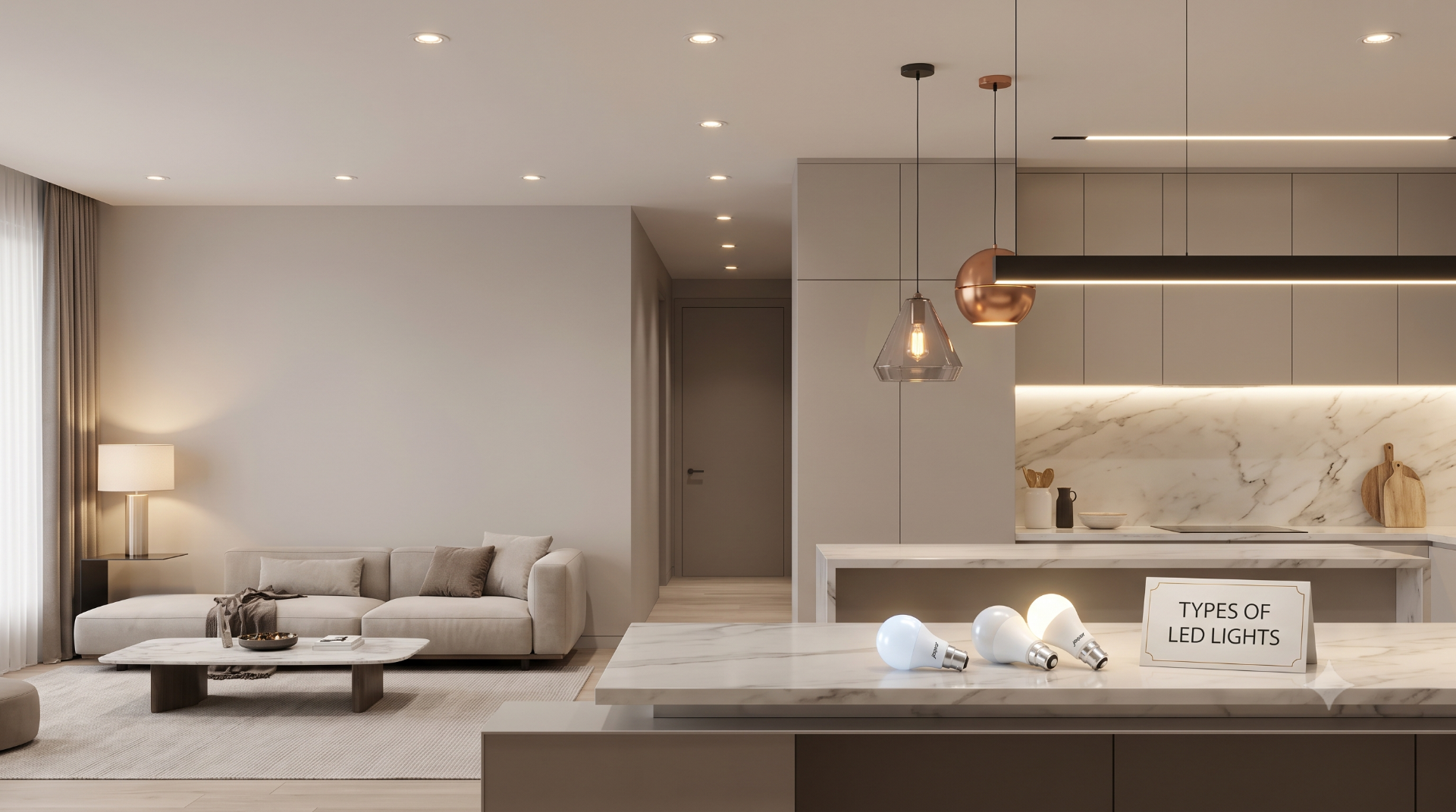
Good lighting rarely comes from a single fixture.
A well-designed interior usually combines several sources, each with a specific role. One fixture may provide broad illumination across a room, another may concentrate light on a work surface, while a third may simply bring attention to an architectural detail or create a softer evening atmosphere.
LED technology has made this approach increasingly practical because the light source can be incorporated into many different fixture forms.
From recessed ceiling fixtures and flat panels to linear systems, strips, decorative pendants and outdoor lighting, LED solutions can be selected around the needs of the space rather than forcing the space to adapt to one type of light.
Jaquar's global lighting portfolio is organised across decorative, indoor and outdoor categories and includes LED lighting solutions for residential and commercial environments.
Understanding types of LED lights is therefore useful not only when buying a fixture but also when planning the lighting character of an entire space.
What Is an LED Light?
An LED, or light-emitting diode, produces light using semiconductor technology.
Its compact nature allows LEDs to be integrated into many different forms. A bulb can replace a conventional lamp source, while an LED can also be built directly into a panel, downlight, linear profile or strip.
This creates considerable flexibility in lighting design.
For homeowners, the most relevant factors are usually:
- Where the light will be used
- How much illumination is needed
- Whether the light should be broad or focused
- Whether the fixture should be visible or discreet
- What atmosphere the room requires
These questions are more useful than simply asking which LED fixture is the “best”.
1. LED Downlights
Downlights provide illumination from the ceiling and are particularly useful when a clean, relatively unobtrusive lighting arrangement is desired.
Jaquar's global lighting portfolio includes dedicated LED downlights in different designs and configurations.
They can be used as individual fixtures or arranged in a planned grid.
Best suited to:
- Living rooms
- Bedrooms
- Kitchens
- Corridors
- Offices
- Retail interiors
- Commercial spaces
The spacing between downlights matters.
If they are installed too close together, the ceiling may become visually crowded. If they are too far apart, parts of the room may appear unevenly illuminated.
The arrangement should therefore respond to room dimensions and the activity taking place beneath the lights.
2. LED Panel Lights
LED panels provide broad illumination through a flat, relatively slim fixture.
They are particularly useful where uniform lighting is required.
Jaquar's global lighting portfolio includes indoor lighting solutions alongside dedicated LED lighting products for residential and commercial environments.
Panels can work well in:
- Home offices
- Kitchens
- Bedrooms
- Living spaces
- Commercial interiors
- Work areas
They are especially appropriate where the ceiling needs a clean and simple appearance.
3. LED Bulbs
LED bulbs are one of the most flexible forms of LED lighting because they can be installed into compatible existing fixtures.
Jaquar's lighting portfolio includes LED bulbs within its indoor lighting offering.
They are useful in:
- Table lamps
- Floor lamps
- Pendant fittings
- Decorative fixtures
- General household applications
This format is particularly practical when the homeowner wants to retain the character of an existing lamp or decorative fixture while using LED technology.
4. LED Batten Lights
Batten lights provide practical linear illumination.
They are particularly useful in spaces where broad visibility and straightforward installation are more important than making the fixture a decorative focal point.
Jaquar's portfolio includes Glaze and Kubik batten solutions.
They can be considered for:
- Utility rooms
- Kitchens
- Workshops
- Storage areas
- Garages
- Offices
- Functional commercial spaces
Their elongated form can also complement long rooms and work surfaces.
5. LED Strip Lights
Strip lighting is one of the most versatile formats because it can follow architectural lines and fit into relatively narrow spaces.
Jaquar's LED strip range includes indoor strip lighting and COB strip solutions.
Strip lights are commonly useful for:
Cove lighting
A concealed strip can produce indirect illumination without making the light source itself prominent.
Furniture details
Strips can add illumination to selected furniture or storage elements.
Wardrobes
They can improve visibility in enclosed storage.
Architectural features
They can emphasise recesses, niches, ceiling details and other linear elements.
The important point is that strip lighting should usually support the architecture rather than become the only source of illumination.
6. LED Linear Lighting
Linear fixtures provide a stronger architectural expression than conventional point-based lighting.
Jaquar's linear lighting collection includes Linear Flex and other linear solutions.
They can be useful in:
- Offices
- Corridors
- Retail environments
- Hospitality spaces
- Contemporary homes
- Architectural installations
Linear lighting can visually extend a room.
A horizontal line may reinforce the width of a space, while a vertical installation can draw attention towards a particular wall or structural element.
7. Track Lighting
Track lighting is useful where several light sources need to be positioned along a defined route.
It can be particularly useful in spaces where displays, artwork or furniture arrangements may change.
Rather than designing every fixture around a fixed position, track systems allow lighting direction to be coordinated with the room's layout.
This makes them useful in:
- Retail environments
- Galleries
- Living rooms
- Workspaces
- Hospitality interiors
8. Magnetic Lighting
Magnetic lighting builds flexibility into the lighting system itself.
Jaquar offers magnetic lighting solutions including diffused linear options and focused adjustable formats.
The system can be useful when a space needs multiple lighting functions along the same track.
For example, one area may require broader illumination while another needs focused light.
Magnetic systems can therefore be particularly useful in contemporary interiors where flexibility is part of the design brief.
9. LED Spotlights
Spotlights provide focused illumination.
They are useful when you want the eye to notice a particular feature rather than illuminate everything equally.
Suitable targets can include:
- Artwork
- Sculptural elements
- Shelving
- Textured walls
- Product displays
- Architectural features
A good spotlighting scheme usually contains a hierarchy.
Choose a few areas to emphasise rather than attempting to highlight every object in the room.
10. Decorative LED Fixtures
Lighting can also become a visible part of the interior.
Jaquar's decorative lighting portfolio includes formats such as chandeliers, pendants, floor lamps, table lamps and wall lamps.
These fixtures can provide functional illumination while also influencing the overall design language of a room.
A pendant may define a dining area.
A chandelier may become the visual centre of a larger interior.
A floor lamp can create a separate reading or seating zone.
A table lamp can introduce a softer pool of light close to furniture.
The fixture should therefore be selected according to both its visual presence and its lighting function.
11. LED Lighting for Different Rooms
Living Room
Living rooms often benefit from layered lighting because they serve multiple purposes.
Start with general illumination using suitable ceiling lighting, panels or downlights.
Then add decorative or accent lighting where required.
A floor lamp beside a chair can create a reading zone, while a wall lamp or spotlight can highlight a feature wall.
Bedroom
Bedrooms usually benefit from softer, more controlled lighting.
General illumination can be supplemented with bedside table lamps, wall lamps or selected indirect lighting.
The objective is flexibility rather than maximum brightness.
Kitchen
Kitchens require good visibility around preparation and work areas.
Broad general lighting should be combined with appropriate task lighting where shadows may otherwise occur.
Home Office
A home office requires consistent general illumination with additional light where detailed work takes place.
Avoid relying entirely on a small decorative lamp.
Corridor
Corridors need continuity.
Downlights or linear fixtures can create an even visual rhythm and avoid poorly illuminated sections.
Commercial Space
Commercial lighting depends heavily on the activity.
Offices may prioritise consistent illumination. Retail environments may need stronger accent lighting. Hospitality spaces often require a combination of functional and atmospheric layers.
12. Understanding Colour Temperature
Colour temperature describes the visual warmth or coolness of light.
Warm white
Warm illumination generally creates a softer, more relaxed atmosphere.
It can work well in bedrooms, lounges and hospitality settings.
Neutral white
Neutral illumination provides a balanced appearance.
It can be useful in kitchens, studies, offices and multipurpose areas.
Cool white
Cooler illumination produces a crisper visual character.
It can be appropriate for some work-oriented, utility or commercial environments.
The choice should always consider the interior and the activity.
13. Why Light Distribution Matters
Two fixtures with similar output can produce very different experiences if they distribute light differently.
A broad beam can illuminate a larger area.
A focused beam can emphasise a specific object.
A diffused fixture can reduce harsh visual contrast.
This is why choosing lighting solely based on wattage is rarely enough.
Consider where the light should go before deciding how much light you need.
14. Watts, Lumens and Efficiency
Watts indicate electrical power consumption.
Lumens indicate visible light output.
When comparing LED fixtures, both can be useful, but they answer different questions.
If you want to understand how much light a fixture produces, look at its lumen output.
If you want to understand its electrical consumption, consider wattage.
A suitable lighting choice balances the amount of light required with the way the space is used.
15. Build a Layered Lighting Scheme
A well-balanced space typically uses three levels.
General illumination
This provides overall visibility.
Panels, downlights and ceiling fixtures can perform this role.
Task illumination
This supports specific activities.
Examples include focused lighting around worktops, desks or reading areas.
Accent illumination
This creates emphasis and visual interest.
Spotlights, strips, linear fixtures and selected decorative lights can perform this role.
The combination is more important than any single fixture.
16. Choosing LED Lighting for Small Spaces
Small rooms require discipline.
Avoid filling the ceiling with unnecessary fixtures.
Recessed downlights can provide useful illumination while maintaining a relatively clean ceiling. A wall lamp can add another layer without using floor space.
Strip lighting can be used selectively to create depth around furniture or architectural details.
The objective is to make the room feel well lit without making the lighting itself dominate the space.
17. Choosing LED Lighting for Large Spaces
Large rooms require greater distribution.
One central fixture may not provide a satisfactory result.
Instead, divide the room into functional zones.
For example, a large living room may include:
- General ceiling illumination
- Sofa-area lighting
- Reading-area lighting
- Accent lighting
- Decorative lighting
Each layer can be controlled according to how the space is being used.
18. Common Mistakes to Avoid
Selecting fixtures independently
Every fixture should contribute to a coherent lighting plan.
Using one colour temperature everywhere
Different rooms and activities can require different visual qualities.
Overusing downlights
Too many points can create visual clutter.
Ignoring glare
A bright fixture can be uncomfortable if it is directly visible from seating or sleeping positions.
Choosing by wattage alone
Light output and distribution are equally important.
Overusing decorative fixtures
A room needs hierarchy. Not every light needs to be a statement.
19. A Simple Selection Process
When choosing LED lighting, follow a practical sequence.
First, understand the room.
Measure its size and consider ceiling height.
Second, identify the activity.
Ask what people will actually do there.
Third, establish general illumination.
Choose panels, downlights or other suitable fixtures.
Fourth, identify areas requiring additional light.
Add task lighting where necessary.
Fifth, introduce visual emphasis.
Use strips, spotlights, linear fixtures or decorative lighting selectively.
Finally, check the overall balance.
The room should feel coherent with both the lights switched on and off.
Frequently Asked Questions
1. What are the main types of LED lights used in homes?
Common options include LED bulbs, downlights, panels, battens, strip lights, linear fixtures, spotlights and decorative LED lighting.
2. Are LED downlights suitable for general room lighting?
Yes. Downlights can provide general illumination when appropriately spaced and selected for the room's size and requirements.
3. Where are LED strip lights most useful?
They are particularly useful for indirect and architectural lighting, including ceiling details, furniture, wardrobes, niches and selected decorative features.
4. What type of LED light is suitable for a home office?
A home office generally benefits from consistent general illumination combined with focused lighting around the main work area.
5. How should I choose between warm and cool LED lighting?
Consider the purpose of the space and the atmosphere you want. Warm light generally suits relaxing environments, while neutral or cooler light can work well in areas where visual clarity and concentration are important.
Conclusion
The value of LED lighting lies in its flexibility.
A downlight can provide controlled general illumination. A panel can cover a larger area evenly. A bulb can work within an existing decorative fixture. A strip can follow an architectural detail. Linear lighting can reinforce the geometry of a room, while spotlights and decorative fixtures can create emphasis.
The best lighting scheme rarely depends on just one of these formats. It combines different sources according to the room, activity, architecture and atmosphere.
Jaquar's global lighting portfolio brings together indoor, outdoor and decorative solutions, allowing lighting to be planned as an integrated part of residential and commercial spaces.