


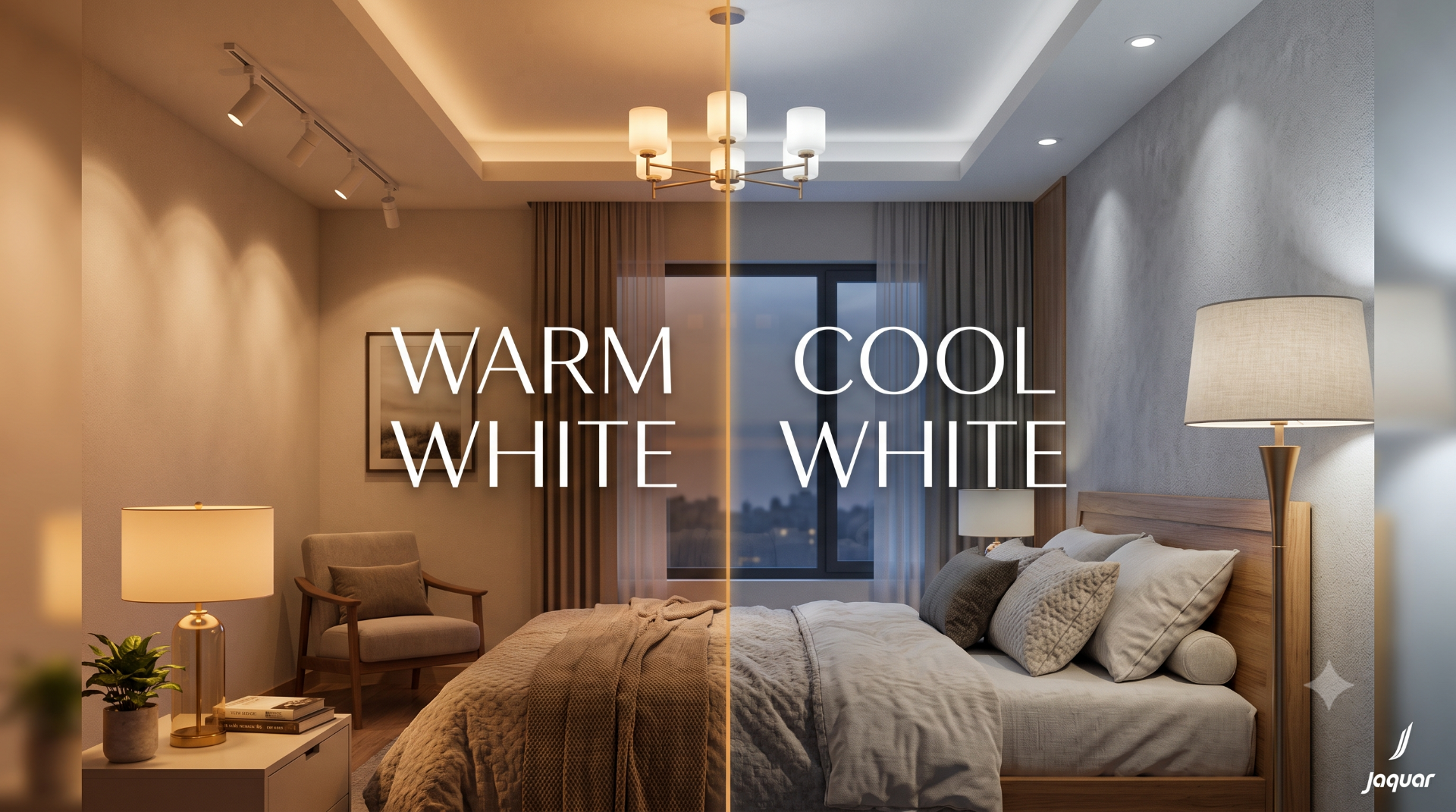
Lighting influences a room long before you consciously notice the fixture itself. It can soften a bedroom, make a work area feel more focused, emphasise architectural details or change how colours and materials appear.
One of the most important decisions behind that experience is colour temperature.
Warm white and cool white are often presented as two competing choices, but they are better understood as different tools for different environments. Warm light tends to create a softer, more relaxed appearance. Cool light produces a cleaner, more energetic visual character. Neutral white sits between the two.
Choosing correctly requires more than looking at the colour of a light source. Room function, natural daylight, interior materials, fixture placement, ceiling height and personal preference all influence the result.
A good lighting plan therefore begins with the space and its purpose—not with the fixture catalogue.
What Is Colour Temperature?
Colour temperature describes the visual appearance of light and is measured in Kelvin (K).
As a broad reference:
- Warm white: approximately 2700K–3000K
- Neutral white: approximately 3500K–4000K
- Cool white: approximately 5000K–6500K
Lower Kelvin values generally produce warmer-looking light, while higher values produce cooler-looking light.
These ranges should not be treated as absolute rules. Different fixtures, surfaces and surrounding light conditions can change how the colour is perceived.
The same colour temperature can therefore feel different in a bedroom with warm timber finishes compared with a room dominated by white walls and reflective surfaces.
Warm White vs Cool White: The Main Difference
Warm white has a softer visual character and is commonly associated with comfort and relaxation.
Cool white appears cleaner and more energetic, making it useful in areas where visual clarity is important.
Neutral white provides a middle ground and can be useful in multifunctional spaces.
The choice should therefore follow the purpose of the room.
A bedroom, for example, may benefit from warmer lighting in the evening, while a home office may call for a more neutral or cooler appearance.
Why Warm White Works Well in Residential Interiors
Warm lighting can complement materials commonly used to make homes feel comfortable.
Timber, upholstery, warm neutrals, textured fabrics and earthy colours can all interact naturally with warmer illumination.
This makes warm white particularly suitable for spaces where atmosphere is an important part of the experience.
Bedrooms
A bedroom usually benefits from a softer evening environment.
Warm white can create a calmer visual setting around the bed, particularly when used through wall lamps, table lamps or pendants.
Living Rooms
Warm lighting can help a living room transition from daytime activity to evening relaxation.
Instead of relying on a single ceiling fixture, combine general indoor lighting with decorative sources at lower levels.
Dining Areas
A warmer light can create a comfortable setting around the dining table.
A pendant or chandelier can establish a visual centre while surrounding ambient lighting remains understated.
Jaquar's decorative lighting portfolio includes chandeliers, pendants, floor lamps, table lamps and wall lamps that can contribute to these layered arrangements.
Where Cooler Light Can Be Useful
Cooler light creates a cleaner visual appearance and can be useful where detailed tasks or focused activity take place.
Home Offices
A study or home office may benefit from neutral or cooler lighting, particularly for reading and desk-based tasks.
However, colour temperature should not be confused with brightness. A cool light does not need to be excessively bright.
Dressing Areas
Dressing areas benefit from clear visibility because clothing, accessories and colours need to be seen accurately.
A more neutral or cooler lighting layer can be useful here while the main bedroom retains a warmer atmosphere.
Functional Areas
Areas where practical visibility is the primary requirement can accommodate cooler lighting more naturally than spaces intended primarily for relaxation.
Where Neutral White Fits
Neutral white provides a middle ground between warm and cool lighting.
It can work well in spaces with several functions or where you want a balanced appearance without strongly warm or cool characteristics.
Studies, corridors, multipurpose rooms and transition spaces can all be considered for neutral lighting depending on the interior.
It can also help connect spaces that use different lighting temperatures.
Warm White vs Cool White for Bedrooms
The bedroom is generally one of the strongest candidates for warm white lighting.
The softer appearance can work with bedding, upholstery, timber and neutral finishes while creating a comfortable environment after sunset.
Layering is important.
General ceiling or recessed lighting can provide overall visibility. A wall lamp, pendant or table lamp beside the bed can provide a lower and more focused source.
Jaquar's lighting portfolio includes indoor and decorative categories that can be combined according to these different functions.
Warm White vs Cool White for Living Rooms
Living rooms are multifunctional.
They can be used for socialising, relaxing, reading, watching television and occasionally working.
Warm or neutral lighting can provide a comfortable foundation, while task-specific lighting can address individual activities.
A floor lamp beside a chair, for example, can create a reading zone without changing the lighting throughout the room.
Warm White vs Cool White for Dining Spaces
Dining spaces often benefit from a warmer lighting character.
The light should complement the table, surrounding furniture and materials rather than compete with them.
A pendant or chandelier above the table can provide a focal layer, while general indoor lighting supports the surrounding space.
Jaquar's decorative range includes both pendant and chandelier categories that can be incorporated into such schemes.
Warm White vs Cool White for a Home Office
A home office requires a balance between concentration and comfort.
Neutral or cooler light can provide a clean visual environment for reading and detailed work.
However, the light should be positioned carefully.
Avoid creating reflections on screens or placing a strong source directly within the normal field of vision. General illumination and focused desk lighting should work together rather than compete.
Warm White vs Cool White for Kitchens
Kitchen lighting is primarily functional.
Clear illumination helps with food preparation, cleaning and other detailed activities, so a neutral or cooler appearance can be useful.
In open-plan homes, however, the kitchen often connects directly with the dining and living areas.
The lighting should therefore be coordinated across the entire space. A functional kitchen layer can coexist with warmer decorative lighting in adjacent areas.
Warm White vs Cool White for Dressing Areas
The dressing area has a more practical role than the rest of the bedroom.
Clearer illumination can help when selecting clothes and distinguishing colours.
A neutral or cooler source may therefore be useful in this zone even when the main bedroom uses warmer lighting.
The important principle is to create a separate functional layer rather than making the entire bedroom cooler.
The Role of Natural Daylight
Artificial lighting should always be considered alongside daylight.
The appearance of a room changes as daylight moves through it. Windows, orientation, glazing, curtains and surrounding structures all affect the amount and character of natural illumination.
A room that looks balanced during the day may feel very different after sunset.
Evaluate the lighting at the time the room is most frequently used.
This is particularly important for living rooms, bedrooms and dining areas that transition from strong daylight to artificial lighting in the evening.
How Colour Temperature Interacts With Materials
Colour temperature influences the way materials appear.
Warm light can emphasise warmer finishes and create greater visual richness in timber and earthy colours.
Cooler light can make whites, pale surfaces and cooler tones appear cleaner.
This means that lighting should be selected after considering the interior palette.
A fixture that looks appropriate against a white showroom wall may create a very different result when installed alongside warm timber, coloured upholstery or textured surfaces.
Should One Colour Temperature Be Used Throughout the Home?
There is no requirement to use one colour temperature everywhere.
Different spaces can have different lighting characters according to their function.
Bedrooms and living rooms may use warmer light, while workspaces and dressing areas may use neutral or cooler lighting.
However, rooms that connect visually should maintain some consistency.
The objective is not uniformity. It is a deliberate transition from one environment to another.
Can Warm and Cool White Be Combined?
Yes, provided the difference has a purpose.
Different colour temperatures can be used to separate functional zones.
For example:
- Warm lighting in the bedroom
- More neutral lighting around a dressing area
- Neutral or cooler lighting in a study
- Warm decorative lighting in the living room
The key is to avoid placing noticeably different colour temperatures next to each other without a clear reason.
When used intentionally, the contrast can help define the functions of different areas.
Lighting for Open-Plan Interiors
Open-plan spaces require particular care because several activities share the same visual field.
A kitchen, dining area and living room may all be visible at once.
Rather than treating the entire area as one room, identify the individual zones.
The kitchen can have practical general illumination. The dining area can have a decorative pendant or chandelier. The living area can use warmer ambient and accent lighting.
The colour temperatures should remain visually compatible even if they are not identical.
Lighting for Compact Spaces
Smaller rooms have less visual tolerance for excessive fixtures.
Recessed lighting can maintain a cleaner ceiling, while wall lamps can provide illumination without taking up valuable furniture space.
A compact pendant can add a decorative element without overwhelming the room.
The lighting colour should also support the desired atmosphere. A carefully selected warmer tone can make a compact residential room feel more comfortable, while functional areas may require a cleaner appearance.
Lighting for Large Interiors
Larger spaces provide more opportunities for layered lighting.
A spacious bedroom might use recessed lighting, bedside wall lamps and a decorative chandelier.
A large living room could combine indoor ceiling lighting with wall lamps, floor lamps and table lamps.
The challenge is coordination.
More lighting should not simply mean more fixtures. Every source should have a clear function or contribute to the overall composition.
How to Choose Between Warm and Cool White
Start with the activity
Ask what happens in the space most often.
Consider the atmosphere
Do you want the room to feel relaxed, focused, lively or neutral?
Study the daylight
Look at the room at different times rather than evaluating it under one lighting condition.
Consider the interior palette
Think about walls, floors, furniture and textiles as one composition.
Look at adjacent rooms
Connected spaces should transition naturally.
Consider fixture placement
A wall lamp beside the bed is experienced differently from a ceiling fixture.
Test before committing
Where possible, assess the actual light in the intended environment rather than relying solely on a specification or product image.
Common Mistakes When Choosing Colour Temperature
Choosing purely by the number
Kelvin provides useful information, but it does not describe the entire visual experience.
Assuming cooler means brighter
Colour temperature and brightness are different characteristics.
Using warm light everywhere
Warm lighting can be comfortable but may not be ideal for every task.
Using cool light throughout a home
A consistently cool scheme can create a more functional atmosphere than intended in residential relaxation spaces.
Mixing temperatures without zoning
Contrast can work when it defines different functions. Random mixing generally does not.
Ignoring the materials
The same light can produce different visual results depending on the room's surfaces.
A Practical Room-by-Room Guide
Space | Useful starting point | Primary consideration |
Bedroom | Warm white | Relaxation |
Living room | Warm to neutral | Comfort and social use |
Dining area | Warm white | Atmosphere |
Home office | Neutral to cool | Visual clarity |
Dressing area | Neutral to cool | Detail and colour visibility |
Kitchen | Neutral to cool | Practical tasks |
Reading area | Warm to neutral | Focused comfort |
Corridor | Warm to neutral | Transition between spaces |
These are guidelines, not fixed rules. Personal preference, architecture, materials and fixture selection should always be considered.
Creating a Complete Lighting Plan With Jaquar
Colour temperature becomes much easier to manage when the entire lighting plan is coordinated.
Jaquar's global lighting portfolio includes indoor lighting as well as decorative lighting. The decorative range includes chandeliers, pendants, floor lamps, table lamps and wall lamps, while indoor solutions include categories such as recessed, surface and track lighting.
This allows lighting to be planned in layers rather than selecting isolated fixtures.
For example, recessed lighting can establish general illumination, a wall lamp can support a specific activity, and a pendant or chandelier can create a decorative focal point.
The colour temperature should then be considered in relation to each layer and the role it plays in the room.
Frequently Asked Questions
1. What is the difference between warm white and cool white light?
Warm white has a softer, warmer appearance, while cool white has a cleaner, more bluish-white appearance. Neutral white sits between the two. The appropriate choice depends on the room's function, materials and desired atmosphere.
2. Is warm white better for bedrooms?
Warm white is commonly suitable for bedrooms because its softer appearance supports a more relaxed evening environment. It works particularly well with bedside wall lamps, table lamps and decorative fixtures.
3. Is cool white better for workspaces?
A neutral or cooler appearance can be useful in workspaces because it provides a clean visual environment for reading and detailed activities. Positioning and glare control remain important.
4. Can different colour temperatures be used in one home?
Yes. Different rooms can use different lighting temperatures according to their function. The transition between connected spaces should still feel visually coherent.
5. How do I decide which colour temperature to use?
Start with the room's purpose, then consider natural daylight, interior materials, adjacent spaces, fixture position and personal preference. If possible, evaluate the actual light within the room before finalising the scheme.
Conclusion
The choice between warm and cool white is ultimately about matching light to the life of a space.
Warm lighting can support bedrooms, living rooms and dining areas where comfort and atmosphere matter. Neutral and cooler lighting can support studies, dressing areas and other spaces where visual clarity is more important.
Rather than applying one colour temperature throughout an entire home, consider each room as part of a broader lighting composition. Different layers can serve different purposes while still working together visually.
Jaquar's global lighting portfolio provides a range of indoor and decorative formats that can support this approach, from recessed and surface lighting to ceiling fixtures, pendants, chandeliers, wall lamps, floor lamps and table lamps.
A coordinated lighting range makes it easier to create consistency while selecting different fixtures for different rooms and activities. Ultimately, the best lighting is the lighting that feels right for the way the space is actually used.